Posts

Weird Tricks To Improve Memory

Image
  Most people struggle with either short-term memory or long-term memory... or sometimes both. It seems that as we age, we both lose the ability to spontaneously memorize (maybe our minds "feel" overcrowded), and to recall that which we have memorized but "archived" somewhere which may appear to be inaccessible. Some simple , albeit weird braintenance tricks can absolutely enhance both your immediate and longer-term memory as well as your ability to access data filed away in your mind. The key methods to memory enhancement are simple: 1) repetition and usage of new data; 2) focusing on pictures of pages instead of on their content (to build eidetic recall); 3) creating silly, offbeat stories involving the data in their order of appearance. A wonderful TED session follows to provide you with some interesting insight into how some of these simple tricks can make you a memory master. Enjoy this presentation, and then see how many of these sequences you can remember af...
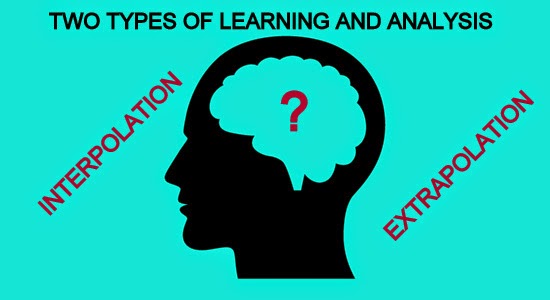
TWO TYPES OF LEARNING AND ANALYSIS

Image
There are two different types of analysis and learning relating to our ability to see and recognize patterns and relationships. One method is extrapolative, which means finding the next item in a sequence of items. The second method is interpolative, which means finding the missing item somewhere in the middle of a sequence of items. We are expressing ourselves interpolatively when we average items -- for example when you are told that an item will cost between $10.00 and $20.00, your mind averages the two together and you think of a "middle" or simple mean average price of $15.00. This is how most people think without realizing that they are doing it. In fact, if you were told that the price would be on the higher side, you would probably interpolate the anticipated price as $17.50 -- we do this by first finding the mean, and then by finding a second mean (or 'derivative mean') between the first mean and the maximum. Our mind dices and slices when we are asked to es...

Exercising The Body Improves Mental Ability

Image
In exercising the body, we stimulate the brain's abilities and capacities. People who are sedentary by their habits or nature are less likely to be as receptive to mental challenges than their vigorously exercising counterparts. Put simply, if you exercise your body, expansion and improvement of your cognition, creativity, neural plasticity, memory and other brain/mind functions becomes easier, and can be achieved significantly more efficiently. While physical exercise is no substitute for brain training, the latter becomes much easier if the former is made part of the whole mind-body fitness regimen. This has to do with a combination of several factors: 1) Increased brain oxygenation; 2) Improved neurotransmitter activity and chemical balance in the brain; 3) Easier ability to focus on intellectual tasks when body is in a relaxing or relaxed state after physical labor; 4) Heightened consciousness following exercise; 5) Brainwave (entrainment status) activity post-exercise is signi...

Pattern Recognition Versus Memorization: Braintenance

Image
Two essential components of intelligence are the ability to recognize (and extrapolate) patterns, and the ability to simply memorize strings of randomized data. Each requires the use of different parts of the brain. Alternating between one and the other creates an increase in both abilities plus increases neuronal plasticity and problem-solving ability. For each of the following strings of data, do the following: 1) Recite all of the data points from memory after looking at the data for no longer than two minutes; 2) Recite all of the data points backwards from memory after looking at the data for another minute; 3) If you recognize a pattern, find the next data point. NOTE: Do not look back to previous strings in working on this exercise! --------------- STRING A: 2, 4, 6, 8, 10, 12, 14 ... STRING B: 1, 3, 2, 4, 3, 5, 4, 6, 5, 7 ... STRING C: 3, 7, 5, 8, 3, 9, 6, 11, 2 ... STRING D: Apple, Bicycle, Carnival, Donut, Energy, Footprint ... STRING E: Carbon, Log, Melon, River, Wheel, Toe ...

Better Vocabulary = More Powerful Intellect

Image
We tend to think in pictures, but we describe those images in words. The better our vocabularies, the better our ability to express what we are picturing, and the more persuasive that we can be. But were you aware that by increasing your vocabulary, you also increase you mind's ability to visualize, conceptualize and think coherently? That is correct. The better and more extensive your vocabulary, the more creative your imagination and the sharper your intellect! My suggestion for taking command of a newly-learned vocabulary word is entailed in the following simple steps: 1) Learn the word (at least one new one per day), and use it in several sentences uttered to yourself , even if this feels a bit unnatural, or forced at first; 2) Close your eyes, and write the word ten times on the blackboard of your mind; 3) Use the word at least three times the next day in conversations with others. For today, you might just look up the true meanings of the often confused and abused terms ...

Knowledge Can Make You Rich

Image
Knowledge Can Make You Rich But Only If You Are Intelligent Enough To Apply It; And Even Then, Only If You Are Motivated To Use Your Intelligence. But you must first understand and acknowledge what knowledge actually is. According to Wikipedia: “ Knowledge is a familiarity, awareness or understanding of someone or something, such as facts , information , descriptions , or skills , which is acquired through experience or education by perceiving , discovering , or learning . Knowledge can refer to a theoretical or practical understanding of a subject. It can be implicit (as with practical skill or expertise) or explicit (as with the theoretical understanding of a subject); it can be more or less formal or systematic. [1] In philosophy , the study of knowledge is called epistemology ; the philosopher Plato famously defined knowledge as " justified true belief ", though "well-justified true belief" is more complete as it accounts for the Gettier problems . However, se...

Dreams And Dreaming: Fascinating Facts - Braintenance

Image
We tend to dream in metaphors about things in our lives which are unsettled and frustrating. This is quite the opposite of what we tend to say about dreams , which tends to be positive in the sense of "you're in my dreams," "I can dream about it if I can't have it," or "I was just daydreaming." In fact, the dreams we tend to remember as adults are very often the ones which are closest to nightmares. The more plagued we are with the stressful components of our lives and either our point of view or our actual environment (the two are never quite the same), the more we dream, and the greater the percentage of our dreams which are perceived as nightmares. In curious contrast, when our conscious minds are at rest after struggling at a perplexing problem for some time, our subconscious, operating through metaphor and unbridled free association, continues to work on these problems in our dreaming states and occasionally solves them. Much of our " Br...