Posts

The Power In Your Words - Braintenance - Douglas E. Castle

Image
The image above bears no relevance to the content of the article which follows.   There is indeed a world of difference between saying "We're trying to..." and "We're going to...". The first one inherently provides for a possible failure, while the second is a completely and unconditionally positive statement. The most important thing is that we understand that we reinforce our thinking by listening to our own words -- in fact, we can't avoid hearing ourselves. We are always told to think positively [and many of our Braintenance readers are already using positive future visualization and other 'conscious' approaches to accessing the Law Of Attraction], but we are not reminded frequently enough to speak positively . The takeaway from this quick article is that we listen to our own words, and talk ourselves into things. If we're going to speak, let's be certain to speak positively to reinforce positive thinking. It's all in the words...

Exercise More Of Your Brain - Braintenance - Douglas E. Castle

Image
The statement above captures the essence of a form of Braintenance "cross-training" and "confusion training," wherein your brain is forced to break through its ordinary routines and to coordinate different tasks in a different matter. These exercises are very simple, but yield tremendous benefits in terms of your ability to focus and to be creative. Following is a sampling of exercises which may prove challenging enough to 'wake up your mind' and to capture your brain's attention. When dealing with the brain, more exercise, and greater diversity of cerebral tasks is always better. Try these: 1) If you are right-handed, try doing as many things as possible with your left hand, and vice versa; 2) Stir beverages, soups, and the like in a clockwise fashion, instead of in the traditional and popular counter-clockwise fashion; 3) Read a page of text from the bottom up, with the last sentences first; 4) Try working backwards for a while (be careful, and avoid t...

Learning Backwards: Braintenance Mind Jolt - Douglas E. Castle

Image
Learning Backwards: Braintenance Mind-Jolt How often have you heard of someone knowing something "backwards and forward(s)"?  There is a reason for this in the etymology of the expression itself: it is generally perceived as being difficult for people who have learned and memorized something in a particular order to be able to learn and memorize it in a different order. Learning something "backwards" requires a (with apologies to Liam Neeson) special skill set. The skills involved are used both consciously and subconsciously every day by most people. In learning backwards, you'll have to use these skills consciously -- at least at first. These skills include visualization (visualizing the list of items with eyes closed), creating acronyms (using the first letter of each image to create a word) and sensory association (i.e., linking a group of things to a simple song, or making them part of a simple story). The benefits to backwards learning are tremendous. The p...

Getting Things Done - Braintenance Technique

Image
If you have had dreams, ambitions and objectives, you know that most of them are never achieved -- not because they were impossible, but because they were never even started. If you would like to get anything done, the key is to visualize what you desire (in terms of the outcome), and to then -- within 5 critical minutes of your visualization process -- take a first action toward that dream, ambition or objective, even if this action is simply reducing the idea to its essence and writing it on your "to do" list. Then within that same day , take a first physical action step (such as making a phone call, registering for an event, visiting a website, etc.) and pledge to yourself to take one additional action toward the furtherance of that which you are seeking to achieve per week at minimum. The greatest acts and deeds are not achieved in giant steps -- they are achieved by incremental consistency; by working conscientiously, one action step at a time until your book is written...

Your Mind CRAVES Orderliness! - Optical Illusions

Image
The conscious and subconscious mind crave orderliness and organization, with each item of data clearly recorded in multisensory detail, and filed in its most appropriate and accessible place. This is why we have routines, rituals and recurring cycles of thought (which sometimes haunt us and which sometimes help us). Look at the picture above. At first, it appears as a meaningless bunch of letters -- but as we study it consciously, it becomes a plainly-worded statement of fact. In fact, when we look at incomplete pictures or have "blind spots" in our foveal or peripheral vision, our minds tend to fill in those blanks for us. This effect is responsible for many optical illusions. And what we see (or think that we are seeing) is a significant input into what we will be thinking. Peripheral vision plays more tricks on us than foveal vision, but our foveal vision can be made to play tricks on us as well. Let's get ourselves some definitions of these two types of vision from Wi...

Weird Tricks To Improve Memory

Image
  Most people struggle with either short-term memory or long-term memory... or sometimes both. It seems that as we age, we both lose the ability to spontaneously memorize (maybe our minds "feel" overcrowded), and to recall that which we have memorized but "archived" somewhere which may appear to be inaccessible. Some simple , albeit weird braintenance tricks can absolutely enhance both your immediate and longer-term memory as well as your ability to access data filed away in your mind. The key methods to memory enhancement are simple: 1) repetition and usage of new data; 2) focusing on pictures of pages instead of on their content (to build eidetic recall); 3) creating silly, offbeat stories involving the data in their order of appearance. A wonderful TED session follows to provide you with some interesting insight into how some of these simple tricks can make you a memory master. Enjoy this presentation, and then see how many of these sequences you can remember af...

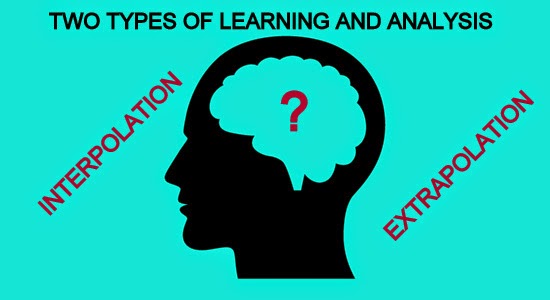
TWO TYPES OF LEARNING AND ANALYSIS

Image
There are two different types of analysis and learning relating to our ability to see and recognize patterns and relationships. One method is extrapolative, which means finding the next item in a sequence of items. The second method is interpolative, which means finding the missing item somewhere in the middle of a sequence of items. We are expressing ourselves interpolatively when we average items -- for example when you are told that an item will cost between $10.00 and $20.00, your mind averages the two together and you think of a "middle" or simple mean average price of $15.00. This is how most people think without realizing that they are doing it. In fact, if you were told that the price would be on the higher side, you would probably interpolate the anticipated price as $17.50 -- we do this by first finding the mean, and then by finding a second mean (or 'derivative mean') between the first mean and the maximum. Our mind dices and slices when we are asked to es...